Almustafa’s Teachings to the People of Orphalese
The ProphetAlmustafa’s Teachings to the People of Orphalese is framed as an answer to a community asking for truth before Almustafa leaves. The people want more than information: they ask him to disclose them to themselves, to speak about what lies between birth and death, and to give them words they can pass to their children and to the generations after them. The teaching begins in a relationship of listening and shared attention, then turns into a public address whose first named subject is love.
A Request Made Before Departure
The people place their request in the shadow of Almustafa’s imminent departure. They acknowledge that his longing draws him toward the land of his memories and the dwelling place of his greater desires, but insist that their love will not bind him and their needs will not hold him. The freedom they grant him makes the appeal for speech more striking: they ask for a final gift without claiming the right to keep its giver.
Their request is explicitly communal. They ask Almustafa to speak to them and give them his truth, then describe how they intend to pass that truth onward to their children and, through them, to later generations. Teaching is therefore presented not as a private exchange between a sage and an individual pupil, but as something that may enter the community’s inheritance. The people seek words that can continue to travel after the speaker has left.
What the People Ask to Understand
The request becomes more intimate when the people ask Almustafa to disclose them to themselves. They do not ask only for an account of what he knows; they ask him to interpret what has been shown to him of the passage between birth and death. The wording makes the teaching’s purpose reflexive: the people hope that his speech will give them a clearer understanding of their own lives.
They also recall the unusual closeness of his position among them. In his aloneness, he has watched through their days and listened while they wept and laughed in sleep. This image makes him both apart from the community and attentive to it. His solitude has not meant mere distance: the people describe him as a witness to ordinary time and to feelings that surface when they are not addressing him directly. Their appeal rests on that accumulated observation, even as they ask him to make its meaning public.
Almustafa’s Answer and the Change to Public Speech
Almustafa’s reply begins by turning attention away from a store of wisdom that belongs only to him. He asks what he can speak of except that which is already moving the people’s souls. The response presents the teaching as an articulation of something active within its listeners, rather than as a truth imposed on them from outside. Their souls are not portrayed as empty vessels waiting for instruction; the words are to meet a movement already underway.
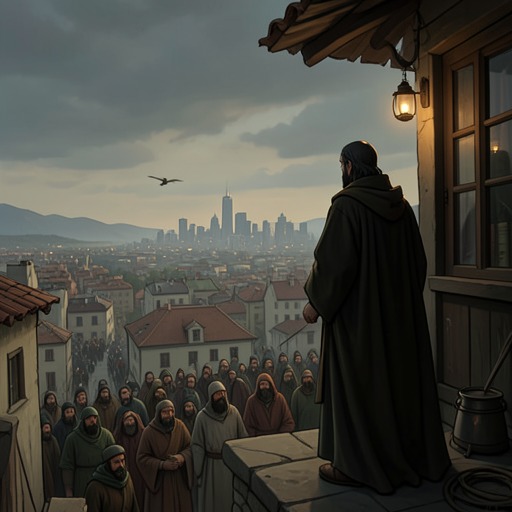
The narrative marks this answer as a change of scene and mode. After the people’s collective appeal, the account says that Almustafa answered; the next image places him before the people, lifting his head and looking upon them. A stillness falls over the gathering, and he speaks in a great voice. The sequence moves from request to attentive silence to address. His teaching is at once intimate in its concern with inward life and public in its delivery.
Love as the First Named Subject
Almitra gives the broad appeal its first specific direction when she asks Almustafa to speak of love. Her intervention narrows the vast question of what lies between birth and death to a subject that can organize the teaching that follows. The request comes before the gathering’s stillness and Almustafa’s heightened public address, so the transition from a personal prompt to a collective lesson is built into the scene.
The opening of the love teaching immediately resists the idea that love is simply ease or comfort: Almustafa says that its ways are hard and steep, even as he urges those called by love to follow. The first lesson thus begins with both invitation and difficulty. In the larger framing of the teachings, this opening answers the people’s desire for insight without promising to spare them challenge. The address takes its force from that balance: it is offered as a gift that may be carried forward, but it asks its hearers to encounter the demands of the life they already share.